

Whether you’re an athlete or a simple sedentary human , bone fractures is a injury that can affect anyone , regardless of age , body type or activity levels. Sustaining a bone fracture is an extremely common injury , accounting for up to 20% of all sporting injuries worldwide in the athletic population and resulting in over 8.5 million fractures in elderly people every year!
These are some massive numbers for structures that make up and play a huge role in our musculoskeletal system. Our bones play a huge role in movement , health and overall function of our daily lives. Sustaining a bone fracture can be a very traumatic experience or just a simple build up.
Fortunately for you , we are experts at bone fractures and wrote this article with you in mind! As you sit tight and begin the first step of your journey to greatness we will go through all the particulars relating to your bone fracture as what to expect , how to manage it and what not to do! So get comfortable , take a break and lets get into your bone fracture.
If your diagnosis is confirmed, please remember to bring all scan, tests, or previous x-rays along to your treatment session.
The Pathophysiology of a bone fracture and how does it happen?
Think of your bones as being a scaffold to your body in which your muscles , tendons , ligaments and nerves can wrap around and travel through. At a cellular level , bones are made up of a variety of minerals and nutrients which provide the effective health of your bones. Calcium , magnesium and collagen are generally the main nutrients found in the matrix of bones to which they provide the strength , rigidness and the flexibility needed to move around. In addition to these , you have specific bone cells known as osteoblasts , osteoclasts and osteocytes which help make new bone and break down bone tissue respectively. Osteocytes are responsible for maintaining a good balance inside your bone matrix. Diving a bit further into your bone marrow which is also found inside your bones , consists of red marrow which are mainly responsible for making new blood cells (red and white blood cells as well as blood platelets) and your yellow marrow which primarily stores fat.
Bones can be further explored in their structure and type , although for the purpose of a bone fracture, we will not go through it.
Bone fractures can occur due to two mechanisms of injury. For your ease of understanding, we will break it down into a traumatic and non-traumatic approach using a basic example of falling off a ledge and falling onto your lower leg.
Traumatic Bone Fracture
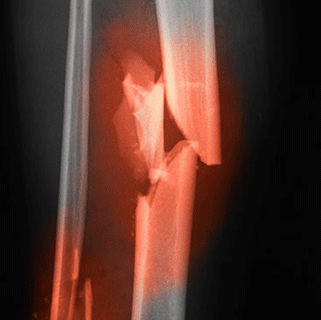
A traumatic bone fracture quite simple to understand as it’s more of a direct injury to your bone. As you attempt to land , you incorrectly fall on your leg. You then feel a sudden snap ,pop or break which is swiftly followed by a immense warmth pain taking over. Swelling is sudden as well as the incapacitation to stand up. Traumatic bone fractures are common in high impact sports , motor vehicle accidents and direct trauma. This merely occurs due to the external force translating through your bone is too much to withstand causing your bone to literally snap. This can be thought of slowly bending a branch of a tree , eventually the force applied to the branch will surpass the strength of the branch itself , causing it to break. We will have a look at the different types of fractures later in this article.
Non-Traumatic Bone Fracture
Sustaining a bone fracture in a non-traumatic mechanism is not uncommon. These type of bone fractures are due to gradually over-loading your bone in which the maximal threshold is eventually surpassed. Over a period of time , the micro stress on your bone results in a fracture. Lets say you’re a hurdle jumper or runner and enjoy a good daily work out. The constant weight coming through each time you plant your heel on the road , means that there is s high velocity force translating through your bone structure. These constant stresses results in a breakdown of bone especially when the load is localised to a specific point such as your shin , heel or knee joints.
Another way of sustaining a bone fracture via a non-traumatic mechanism is through auto immune disorders whereby your immune system is compromised. These are conditions related to weakened bone density which makes you more susceptible to bone fractures. These type of conditions include bone cancer and osteoporosis.
Get to the root cause of your problem
Our team of experts guide you to heal
How severe is my bone fracture….?
Fractures vary in how they present , the type of symptoms they present with and how severe they can be. These can range from a “small” crack to a more intense break. Using a basic example of landing onto your legs from a height , we will discuss the clinical signs and symptoms of just how severe your bone fracture is , the main differences to look out for and why some are more severe than others.
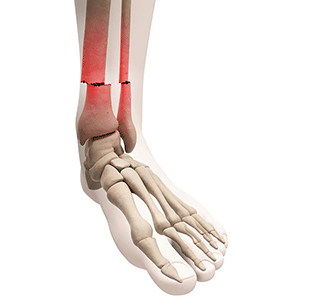
Lets say you landed on your legs coming off a ladder or stairs. As you landing you can feel a sudden and intense crack inside your bone. The injured leg will begin to turn red and swelling is immediate. The inability to stand up comes with it as well although you’re still able to move your leg or foot through it’s range but not without significant pain. The pain is localised to your injured leg only and can be gauged on the amount of movement you try to do with your injured leg. These are some checkboxes that indicates a stable non-displaced fracture. This simply means that the although the bone is fractured , it has not moved away or is only slightly displaced from the beak point and can therefore be considered as stable. There will be no surgical intervention needed as the break point of the fracture is in a acceptable place to be able to heal on it’s own. These types of fractures can be further classified into a greenstick , stress or avulsion fracture.
Keeping with the same example of landing from a distant height , you feel a sudden intense crack inside your bone. This is followed by pain so immense that you could pass out along the a sudden onset of swelling not just at the injured site but into the entire leg itself. You are unable to move or stand and cannot even wiggle your foot. The pain is radiating into your entire body regardless if you moving or not. These checkboxes are indicative of fractures that can be classified as displaced unstable fractures. These types are worse and more severe as the break point of the bone needs to be realigned in order for healing to occur , this is usually done via surgical intervention. These types of bone fractures can be further identified into transverse , oblique and compound bone fractures. If the fractured bone pierces through the skin , it is a medical emergency as the wound and exposure of the bone outside the skin makes the risk for infection much higher.
Diagnosis
Physiotherapy diagnosis
With our professional expertise and clinical knowledge we can make the Physiotherapy diagnoses for your bone fracture a easy , uncomplicated and well understood process. We are skilled enough to calmly guide you through a structured assessment process whereby we can confirm or even rule out a bone fracture.
We are able to isolate and break down the affected joint and associated bone fracture in order to get the best possible clinical presentation of you. Lets have a look at the thorough steps we will guide you through as we identify and confirm your bone fracture:
Subjective Assessment
Getting an idea of the events and mechanism of injury to your bone fracture as well as any relevant previous history , medication or chronic conditions you may have gives us a better insight into your path that lead you to us. The better we are able to understand this , the better and easier we are able to plan your rehabilitative journey. Another important aspect of this is to go through your goals and expectations as we strive towards getting you back into the tasks that are important to you within a realistic and objective approach.
Physical Assessment
This is where we assess your physical ability in relation to your bone fracture and surrounding structures. We are able to isolate and measure your joint mobility or restriction as well as applying a variety of special tests to ensure we get the best clinical picture of your injury. We therefore not only assess your bone fracture but also see how it impacts your surrounding muscle strength , ligament stability and overall functional ability. Once we able to objectively tick these boxes we are now able to successfully commence your rehabilitative journey. If we suspect any further investigations , we are able to provide you with a referral to get it done. We are proactive in our approach and pride ourselves in taking responsibility as your primary health care provider.
We understand how the body works and know how to mitigate any secondary issues that may arise when having a bone fracture. Allow us to take on that responsibility while you focus on a structured rehabilitation program to get you back to your best.
X-rays
X-rays are the mainstay intervention when it comes to bone fractures. We are skilled to assess and diagnoses your bone fracture based on an x-ray scan. X-rays will provide us a detailed insight into the severity , integrity and stability of your bone fracture whereby we assess any cortical stress lines , breaks or displacements of the bone.
What are you looking for on an X-ray? Cortical stress lines, Displacement measurements, What Classification is done via X-ray?
Your physiotherapist can refer you to get x-rays taken if necessary.
Diagnostic ultrasound
Diagnostic ultrasound will not be able to identify any bony fractures but can indicated the presence of bone trauma via a diagnoses of swelling or oedema collection surrounding the bone fracture. This is usually not the first choice of intervention when needing to identify a bone fracture.
A ultrasound can however , indicate if theres damage to the ligaments or tendons surrounding your bone fracture.
If you need an ultrasound, your physio will refer you.
MRI
An MRI scan will be able to image all of the affected structures therefore being able to assist with the diagnoses of your bone fracture as well as potential trauma to your muscle, ligament and tendons. However, for a bone fracture an MRI is unnecessary and very expensive.
If your physiotherapist suspects anything more than just a muscle spasm, you will be referred to the right specialist.
Why is the pain not going away?
When your bone fractures , it does not only fracture in isolation. Apart from the type and severity of fracture , which will also impact your healing – there are multiple factors outside of your bone fracture that also needs to heal correctly. Surrounding structures such as your ligaments , tendons , muscles and nerves are certainly affected by your bone fracture , which could certainly prolong your anticipated healing process.
In order for your bone to heal it needs to follow a strict pathway of healing and loading. If complications arise in any of these healing stages , you’ll still experience symptoms long after you’ve sustained a bone fracture.
If you go around “waiting and seeing what happens” , you are simply setting yourself up for further complications. A bone fracture heals via immobilising and then by implementing a gradual loading rehabilitative protocol. By “waiting and seeing” , you are simply not allowing the bone to heal appropriately and will soon find yourself in a heap of further complications. Bone is well supplied by blood, however it needs to be optimally stimulated to allow blood flow and nutrients into the fractured site. Without this , even a simple bone bruise will fail to heal adequately.
Without following a effective rehabilitation program , your fractured bone will not be able to withstand forces that it was previously used to. This is due to not only the bone needing to heal but attention needs to be paid to the structures surrounding your bone fracture. Muscles , ligaments , tendons and nerves are all primary structures that surround your bone fracture. Therefore , these are all structures that need to be rehabilitated in order for the entire chain to be stronger and ensure that you do not become stuck within a cycle of pain whereby the bone is not healed causing deformity , joint stiffness , swelling and pain. Secondary to this presentation , you will begin to see your muscles decrease in size and power , your tendons and ligaments will become weaker and stiffer and even your nerves will begin to present with neurological symptoms.
We are experts at preventing and setting you on a path to correct these complications. Do not let it worsen or restrict you from the basic daily activities that you should be able to do. Have us guide you through this journey with care , passion and clinical mastery.
What NOT to do
What you should do
Making the injury worse
Problems we see when patients come to us with a bone fracture ..
Non – union , delayed union and mal-union are all complications we often see in individuals who do not follow a coherent and effective healing path. These are terms that refer to healing complications associated with bone fractures , whereby the fractured bone fails to rejoin itself (non-union) or whereby the onset of rejoining is later than anticipated (delayed union). Mal-union refers to the fractured bone rejoining itself at the fractured site but does not align correctly causing further restriction , swelling and pain. Within all of these complications , the bone itself is primarily affected – resulting in pain , incapacity and prolonged healing. By not being able to successfully join , you are missing out on the first step of your rehabilitation journey. If this does not happen , the rest of your rehabilitation cannot commence. Do not be another statistic , evidence shows that up to 10% of bone fractures do not heal correctly!
Another common misconception about bone fractures are individuals who skip their rehabilitation phase , thinking that once the bone is healed – functionally will miraculously return. This is completely incorrect as allowing the fracture to heal is merely to first step of your rehabilitation journey. Joint stiffness , muscle loss , complex regional pain syndrome , post surgical arthritis and severe functional limitations are just some of the complications we experience in individuals who have skipped out on their rehabilitation following a bone fracture. Muscles attach to bone via tendons , therefore if your bone fracture is not healed and not able to move through it’s range of motion , your muscle and tendons will begin presenting with secondary issues such as loss of muscle bulk and power as well as tendon inflammation.
Do not set yourself up for failure by missing out or delaying your rehabilitation. We are experts at this , do not ignore your limitations or complications following a bone fracture. Allow us to assess and be proactive in your return to functional.
Get the help you really need
Medical professionals that care about you
Physiotherapy treatment
We are absolute professionals and experts when it comes to our clinical assessment and treatment protocols. We are confident , systematic and use a guided approach to establish the extent of your bone fracture and effects it has taken on your surrounding structures. Our Physiotherapy ensures that you get the best treatment and care while we use an array of different modalities , techniques and necessary guidance to aid you through your rehabilitative journey.
We begin by assessing and confirming the extent of your bone fracture on your joint , muscle and functional capacity. We are able to not only focus on the optimal loading to get your bone stronger but also incorporate various protocols to ensure that any secondary issues such as joint stiffness and muscular compensation are dealt with accordingly. We are able to mitigate these issue by being thorough in our approach to ensure that the bone fracture remains the main issue.
With our expert guidance and knowledge we base our Physiotherapy treatment on your specific needs as we walk you through each healing phase , beginning with the important first step in which you get enough rest , decrease the pain and swelling as well as ensuring you know how to manage your bone fracture effectively. This enables us to build on the solid foundation laid out as we begin our process of remodelling the bone fracture , gradually weaning you out of your sling or crutches. With our toolbox of passive and active techniques such as joint and tissue mobilisation, laser therapy , strapping , dry needling and exercises prescribed , you will see results as swiftly as allowed.
We are experts in our field and have extensive experience in achieving your objectives by using a variety of refreshing and clinically sound treatment protocols. Allow us to get you back to where you need to be , in the most timely manner possible. Let your mind be at ease while we sweep away any fears and instil a level of confidence you were not aware you had.
Phases of rehabilitation
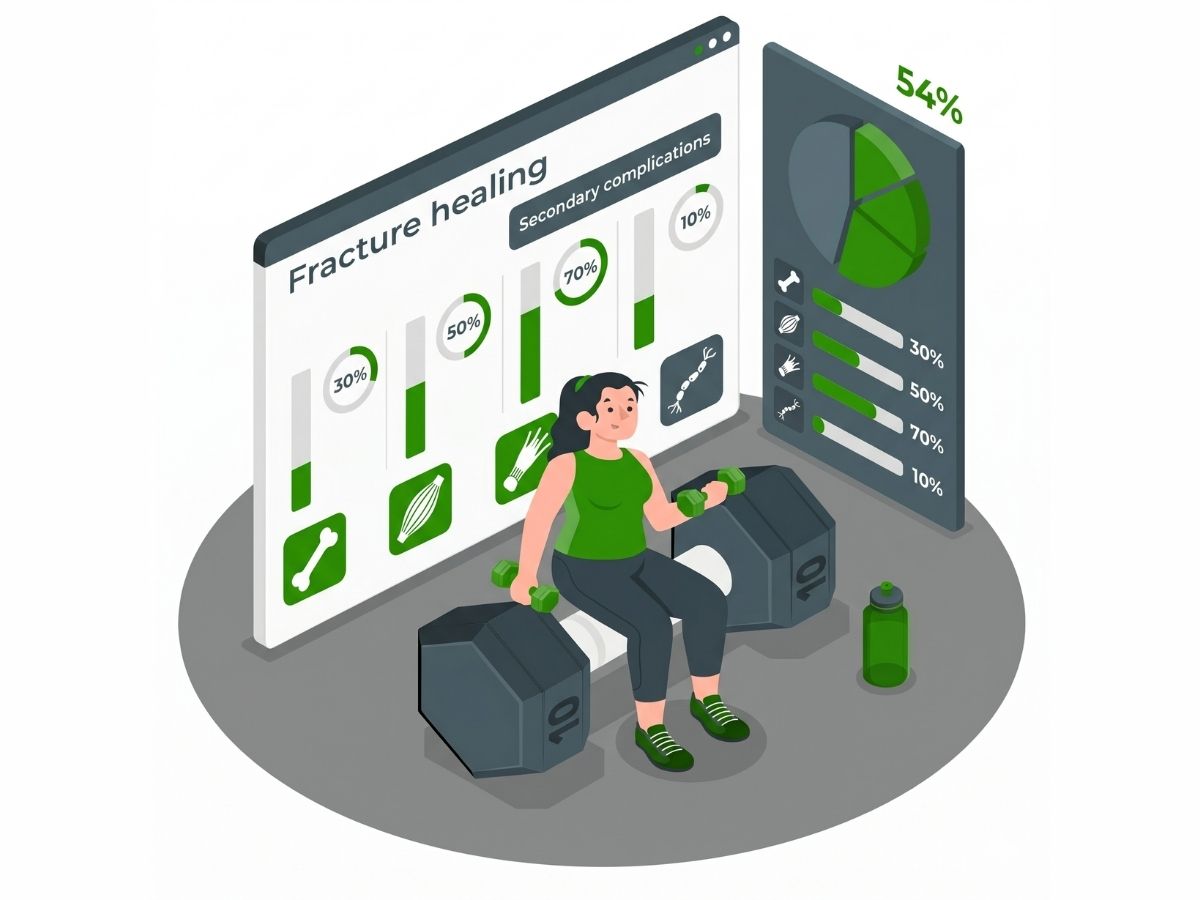
Simply put , healing of a bone fracture occurs in 4 stages. Rehabilitation of your bone fracture will occur within these 4 stages and will consist of 5 Physiotherapy phases. We will briefly outline what is important in these phases as we lay the foundation to build upon. Focussing on the optimal amount of loading we will ensure that your rehabilitation journey is smooth , effective and clinically at the highest level. We are able to navigate your journey through a systematic approach whereby we plan , intervene and progress you according to your set objectives.
1st Phase: Educate , unload and rest (Inflammatory stage Week 0 – 2)
Rest and educate
Healing and resting is imperative in the first phase. Here we will take the time to listen , process and educate you on how to best manage and mitigate any flare up’s that will occur within relation to your bone fracture. Simple yet effective protocols will be administered whereby we educate you on how to keep your joint elevated , protected and how to still be functional in these early days. The better you understand your bone fracture , the easier it is manage and know why some symptoms are present. Bone healing takes time and by equipping you with the advice and necessary tools for recovery , we are able to strive on the correct path of healing.
Medication
Weaning you off medication as soon as possible is always what we strive for in the first phase. Navigating the type of medication can be tricky if you do not know what is appropriate and which is not. We would always want to prevent any secondary issues that can inhibit your recovery time such as stomach ulcers , constipation or drowsiness. We are experts at weaning you off your medication and will safely advise you how to go about doing so.
Mobilisation and muscles
If you’re on crutches or in a upper limb cast , we will advise you on how to safely mobilise , ensuring that you do not have any accidents. Within your pain threshold , we can gently start passive and active movements to slowly introduce movement back into the joint. Muscle strengthening exercise’s such as isometric contractions will be started at a very basic level to begin fibre contraction and blood flow into the affected bone fracture.
By managing the first stage of bone healing , we can then move onto the second level of rehabilitation provided you should be able to:
- Functionally mobilise effectively without any fear and limited pain.
- Note a decrease in swelling , discolouration and tenderness around the fractured site.
- Able to hold a isometric muscle exercise for at least 3 reps (3 sets) of 10 seconds.
2nd Phase: Mobilise and Regain (Soft Callus Formation Stage Week 2 – 4)
As the inflammatory stage has now been managed successfully and passed , we begin by slowly implementing protocols that further optimally stress your bone fracture in order to aid the soft callus formation at the fractured site. By allowing oxygenated blood flow via modalities such as laser therapy we can enhance the healing process of your bone fracture amongst an array of specific loading strategies. Additionally we also begin on mobilising any scar tissue to allow unrestricted movement within your limitations.
By the end of this phase you should be able to:
- Able to partially put weight on the fractured leg with crutches (If fracture is in your lower limb)
- Swelling and discolouration resolved.
- Able to move your fractured bone within a pain-free range.
3rd Phase: Remodelling Phase (Hard Callus Formation Stage Week 4 -8)
In this stage your bone fracture has now likely unified and is able to withstand more load and stresses coming through it. Building on this we can begin more intense active movement of the fractured limb. This allows further consolidation of the soft callus previously laid down in phase 2. We can begin weaning you into a full weight bearing activities as your bone fracture will be able to tolerate more load. Muscle exercises are progressed into concentric patterns allowing full activation of muscle tissue through your allowed range of motion. Focus is primarily paid to promoting further functional capacity such as integrating into driving and gym training.
By the end of this phase you should be able to:
- Weaned off fully from your crutches or upper limb cast.
- Perform a pain free contraction through movement of at least 6 repetitions of 3 sets.
- Integrate into further functional activities such as driving.
- Able to perform simple body weight exercise’s such as a squat or modified push up within boundaries.
4th Phase: Remodelling Phase continued (Bone Remodelling Stage Week 8 – 12)
As we approach the final phase of your bone fracture , we begin to focus at integrating you back into your end stage objectives. Thus meaning increasing your rehabilitation load with focus on furthering your strength , endurance mobility and stability. We are now able to continue building up the tensile resilience of your bone fracture and musculature as we approach the final clearance phase. We continue with the use of our passive and active modalities while progressing you accordingly in your rehabilitation program. By the end of this phase you should be able to:
- Have fully integrated back into simple functional exercises without any pain.
- Returned to training / gym within your limitations.
- Minimal to no pain with exercises or movement patterns.
- Completely weaned off any walking aid or sling.
5th Phase: Test return to normal life (Week 12 – 18)
Generally speaking Phase 5 is the “final test” phase in which we begin preparing you for a full unrestricted return to the activities you love. Although this can take longer than 18 weeks (up to 32 weeks in some instances) this is a brief outline of where you should be. In order to ensure that what your bone fracture is stable , surrounding structures are strong enough and your functional capacity is maintained , we are now able to test , stress and retest in phase 5. This is imperative before making a full return to your activities as without it , you will not have the confidence and peace of mind needed to perform at your highest level of function.
By the end of this phase you should be able to:
- Know which movements and exercises are important for you to ensure you maintain your progress.
- Fully integrated back into your activities without any pain or discomfort.
- Have the confidence in your ability to perform at your highest capacity again.
- Have integrated into higher end stage exercises such as basic jumping , jogging and explosive movements.
Healing time & other forms of treatment
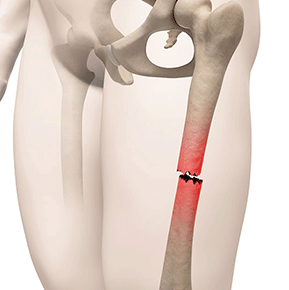
Healing time for a fractured bone varies amongst individuals. Numerous predisposing factors such as age , functional level and chronic conditions play a role in your healing process , all of which directly affects your rehabilitation progress and ultimately your return to function. Lets have a look at the different healing times for bone fractures across non-surgical vs surgical approach.
Non – Surgical Approach
The severity and location of your bone fracture will certainly play a huge role in your full recovery. For example , a hairline fracture in your finger will heal a lot quicker than a hairline fracture in your ankle. However the process is similar and the rehabilitation should follow the same path. A non-surgical approach will entail you being immobilised for a period of time , thus lasting anywhere between 4 – 8 weeks. Once this is completed , a full rehabilitation protocol should be followed thus enabling you to reach your full capacity anywhere between 8 – 12 weeks.
That said , this timeline refers to a small fracture and your full capacity could even be achieved much sooner (Even at 6 weeks). However , should your bone fracture be a bit more serious you can expect a longer time to be immobilised (Such as in a hardcast or sling) for up to 12 weeks , followed by rehabilitation. In this case , a full return to capacity can be expected around 14 – 18 weeks.
Surgical approach
Following surgery , there will be much more factors to take into consideration therefore extending your healing time. Your surgeon would want to ensure that your wound heals correctly , seeing you at 4 or 6 weeks post surgery. They would also want to send you for a 6 week follow up x-ray to ensure that the hardware is stable and integrating nicely into your bone. Once these factors are seen to , rehabilitation can get aggressive and progressed over the next 12 weeks. A full return to capacity can be expected between 22 – 26 weeks.
Given our expertise , we are able to accelerate your healing process by implementing or referring you for different types of supplementary treatment protocols. By being able to identify your needs and end goals we strive towards your objectives not only within our scope of practice but by reaching outside the box and identifying different forms of treatment that can aid you in your path.
Lets have a look at some of our strong alternative and additional forms of treatment that can aid us in your rehabilitation journey:
- If need be , a referral to your local GP will aid us in the appropriate medication for your healing and rehabilitation process. These could consists of analgesics , muscle relaxants and anti-inflammatories.
- Hyperbaric Oxygen Therapy (HBOT). Oxygen therapy has shown to accelerate healing by delivering 100% pure oxygen to your musculoskeletal system. By delivering a higher concentration of oxygen to your fracture bone , healing occurs much quicker as there is an increase in your oxygenated cells. This , however can only be done once you have had a thorough assessment by one of our expert Physiotherapists. Nutritional and supplements. Within our domain we are able to guide you through the process of supplements and nutritional advice to accelerate your healing process.
- High intensity laser therapy to aid blood flow into your fracture bone site, resulting in an decrease in swelling and increase in healing.
- Platelet replacement therapy (PRP). PRP therapy is issued by one of our sport physicians in which we are able to draw your own blood , using it to develop a high concentration of oxygen rich platelets and infiltrate it back into your blood stream. This is a safe procedure and increases your healing time significantly.
Is surgery an option?
Having surgery on a broken bone is quite common. Surgery becomes a necessary intervention dependant on the location , severity and clinical importance of the specific bone you have fractured or broken. Usually smaller bones and breaks do not require any surgery , provided the bones are stable, non-displaced and the fracture is of lesser severity.
Lets have a look at the type and example of bone fractures that do not need surgical intervention.
Non-displaced stable fractures – This refers to the bone being fractured but it has not moved out of it’s normal position and it therefore still stable. With a low grade fracture such as a stress or hairline fracture , surgery will not be indicated. This is very common is children and adolescents whereby a conservative approach is preferred. Hairline and stress fractures in the forearm , foot or knee surface is a common type of non-displaced fracture that is much better treated conservatively.
Comparatively , if you sustained a more traumatic bone fracture whereby the break is more complex as well as there being a higher chance of severe secondary complications then surgery is indicated. Surgery is designed to re-aligned your bone , give stability to the joint as well prevent further disability. Below are some indications that a surgical approach is needed:
- The bone is displaced and not stable.
- It is protruding through your skin.
- You’ve sustained multiple fractures and there are loose laying fragments of bone inside your joint capsule (Comminuted fracture)
- You’ve sustained a bone fracture to a weight bearing joint such as your femur head and hip joint.
- You have a neuro-vascular compromise.
- A conservative approach has failed.
These are some of the clinical boxes that indicated surgical intervention is necessary as a conservative approach will not be able to help. A popular type of surgery will be explained below as it covers what all bone fracture surgeries entail – to realign , fixate and stabilise.
Open reduction internal fixation – An ORIF is a popular type of technique used to realign a broken bone and give it stability again. This is done by a orthopaedic surgeon. Once opening up and realigning the fractured bone , the surgeon then uses an array of stabilising equipment to internally give fix the broken bone. These can range from:
- Plates
- Screws
- Nails and rods
- Pins and wires
These can be moved at a later time depending on the surgeons protocol. Surgery is merely the first step in a rehabilitation journey as we will then guide you through your unique post-operative rehabilitation program. This is important as the surgeon is responsible for putting in the hardware , although we are responsible and able to get the hardware working back to its full capacity.
What else could it be?
- Bone Contusion – Bruising of the bone itself due to trauma. Can be misdiagnosed as a boney fracture.
- Joint Dislocation – The bones of the joint has moved out of place causing severe pain and swelling. This can be misdiagnosed as a fracture.
- Degenerative Joint Disease – Inflammatory diseases such as osteoarthritis causes swelling , pain and bone deformities which can be mistaken for a bone fracture.
- Osteomyelitis – A infection of the bone characterised by localised pain , swelling and tenderness.
- Bone Tumor – A benign or malignant tumor which attacks the bone.
Also known as
- Broken bone
- Bone fracture
- Orthopaedic fracture